

If you're thinking about hiring remote developers, this is the only guide you'll need to find A players who consistently deliver results.
At Remote Crew, we've hired 150+ remote developers and interviewed 1,500+ candidates across every imaginable role. The insights on how to hire the best remote developers you're about to see come from real data and experience.
Without an established brand, most companies waste weeks reviewing the wrong candidates. They define roles poorly, overvalue years of experience, and wait for applications instead of doing targeted outreach.
This guide will show you how to make the best developers in the world want to work with you-even if you're not a Fortune 500 company.
In this guide, we'll cover three phases: Before, During, and After hiring.
This is the only guide and playbook you'll ever need to hire the best remote developers. Let's get started.
Key Takeaways on Hiring Remote Developers
After 1,500+ interviews and 150+ successful placements, here's what actually works when hiring remote developers:
- Focusing on "years of experience" is a mistake. It filters out high-potential candidates with 3-5 years AND top performers looking for career progression. You're left with average performers who can't get promoted elsewhere. Motivation predicts success better than years on a resume.
- The best candidates never apply. 90% of top engineers respond to recruiter outreach, not job postings. If you're waiting for applications, competitors are reaching your ideal candidates first. Outreach delivers first responses in 48 hours, rather than weeks, compared to job boards.
- The first phase determines 80% of hiring success. A 1-page role kickoff document prevents the disaster where the founder wants one thing, the tech lead wants another, and you reject candidates for reasons nobody documented. This takes 2-3 hours and saves 20+ hours of wasted interviews.
- Hiring remotely offers more benefits than on-site hiring. Top talent in Portugal, Eastern Europe, and Latin America costs 40-60% less than US rates while delivering comparable performance. That's either 2x the team at the same budget or significant savings without quality trade-offs.
- Keep tests under 2 hours. Longer tests filter out candidates with options. Provide starter templates, so candidates can implement features rather than setting up everything from scratch. This attracts strong performers while still validating skills.
- Use structured interviews. Ask the same core questions to every candidate to enable fair comparison. Evaluate both technical capability and motivation. A motivated 4-year engineer excited about your challenges will outperform a burned-out 8-year engineer looking for a paycheck.
- Systems matter. Companies with systematic approaches hire in a few weeks. Those jumping straight to interviews without alignment waste 12-16 weeks and still make mediocre hires.
If you need experts who will hire you the A players and the best developers for your needs, book a free session with Remote Crew. Hiring remote developers with us won't cost you a penny until we find you the best-fit candidates.
Why Hire Remote Developers Instead of On-site?
Remote hiring unlocks three distinct advantages that on-site hiring cannot match in 2026's competitive talent market: access to global talent, cost-effectiveness without quality trade-offs, and speed to hire.
Expanding your candidate pool from one city to entire time zones dramatically increases your likelihood of finding the top 3-5% performers who match your exact tech stack and culture. The quality you'd get by paying someone $100k in the USA is the same as hiring from Eastern Europe for $50-70k.
Remote hiring with structured outreach can deliver first candidates in 48 hours, rather than weeks, compared to local talent pools.
Here's an in-depth comparison table between remote and on-site developer hiring.
Criteria | Remote | On-Site | Why It Matters |
Talent Pool Size | Global (millions) | Local (thousands) | 100x more candidates to choose from |
Time to Hire | 48 hours to first candidates | 2-4 weeks minimum | Faster hiring = faster shipping |
Cost Range (Senior) | $50-70k (Eastern Europe/LatAm) | $100-150k (US markets) | 2x the team at same budget |
Specialized Skills | High availability globally | Limited by local market | Access niche expertise easily |
Infrastructure Costs | Usually $0 (candidate provides), but if you prefer you can send work equipment. | $3-7k per seat | Significant overhead savings |
Bottom Line | Best for startups, fast-growing teams, companies needing rare skills | Best for highly regulated industries requiring physical presence | Remote wins for 80% of tech companies |
The Three Phases of Hiring Remote Developers
Most companies jump straight to Phase 2 (interviewing candidates) and wonder why they end up with a three-month hiring process that brings mediocre hires. Successful remote developer hiring requires a structured three-phase approach:

- Phase 1 - Before Hiring is where 80% of failures originate. This means clearly defining the role, aligning all stakeholders on expectations, understanding salary realities, and creating candidate-focused job descriptions. Without written alignment, your founder expects one thing, your engineering lead expects another, and you reject candidates who would have been perfect for one stakeholder but not the other.
- Phase 2 - During Hiring is focused on attracting A players through outreach, not waiting for applications. The hiring landscape has inverted - the best candidates have options and respond to messages on LinkedIn. They don't apply to job boards. This phase includes sourcing with the concentric circles method on LinkedIn, interviewing with structured questions, and testing effectively.
- Phase 3 - After Hiring covers onboarding remote developers with SOPs, setting them up for success in the first 60 days, and creating feedback loops to catch issues early.
Each phase has specific frameworks and counterintuitive insights from our 1500+ interviews. The next sections break down exactly what works at each stage.
Part 1: How to Prepare for Hiring Remote Developers
Most hiring managers start with vague job descriptions and wonder why they waste weeks interviewing misaligned candidates.
On the other hand, we also have the "alignment issue": The founder wants one thing, the engineering lead wants another, and candidates get rejected for unwritten reasons no one bothered to document.
This phase decides 80% of your hiring success before you write a single job post or schedule an interview. Let's see what you need to do.
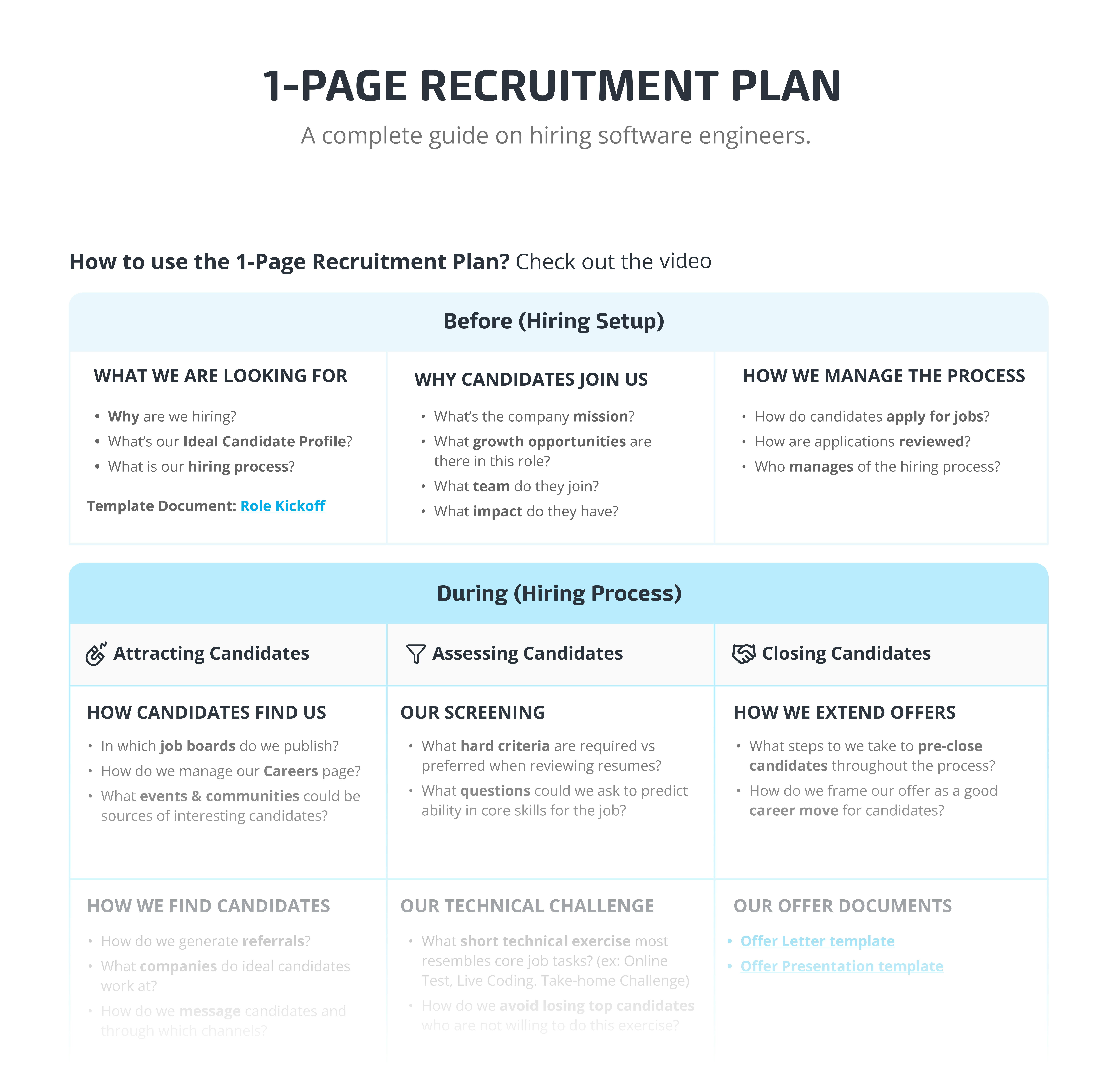
Create Your 1-Page Role Kickoff Document
The best recruiters spend MORE time defining roles upfront and LESS time searching for candidates. That's the opposite of what most companies do.
The problem is that without the written role definition, everyone operates on different assumptions. The founder might want to hire a $40k/year junior full-stack engineer to train for the long term. The team lead writes a job description requiring 5 years of experience because "we need someone who can contribute immediately."
What happens is that you end up passing on high-potential juniors who don't meet the arbitrary experience requirement, AND end up attracting mediocre 5-year candidates who can't find better jobs. Nobody wins.
A 1-page role kickoff document prevents this disaster. It forces alignment before you waste time interviewing candidates who would satisfy one stakeholder but frustrate another.
What Does the Ideal Role Kickoff Document Look Like?
After analyzing 1500+ interviews, we found that having three key sections inside your role kickoff document is the best:
- Business Problem (150-200 words): Describe the specific problem this hire will solve, the tasks they'll handle, and the impact they'll have. Be concrete. Not "improve our platform" - that means nothing. Instead: "Rebuild our authentication system to handle 100K daily users" or "Own the migration of our monolith API to microservices affecting 500K users." This clarity helps everyone understand what success looks like.
- Ideal Candidate Profile (200-250 words): Separate hard skills from soft skills explicitly. For hard skills, list must-haves versus nice-to-haves. Example: "Must: 3+ years Python, FastAPI experience" versus "Nice: AWS, Docker knowledge." For soft skills, focus on motivation, attitude, and learning ability over years of experience. Define what "senior" or "junior" actually means for your company specifically - don't assume everyone shares your definition. One company's senior engineer is another's mid-level.
- Why They'd Join (150-200 words): Answer this question honestly: "Why would someone currently working at a competitor leave to join us?" Include specific selling points like compensation range/structure, technical challenges they'll own, learning opportunities from the team, growth path (e.g., "Clear path to tech lead within 12-18 months"), company mission/impact, and work flexibility. If you can't answer this convincingly, you'll struggle to close strong candidates.
Also, don't forget about the alignment requirement: Have the founder, hiring manager, and any technical interviewers review and sign off on this document before posting the role. If they disagree on what "ideal" looks like, resolve it now - not during interviews when you've already wasted 10 hours on a candidate the CTO will reject.
Spend 2-3 hours creating this document. It will save you 20+ hours of wasted interviews with misaligned candidates.
If you want to kickstart this process faster, get a free 1-page recruitment plan template from our website.
Avoid the Experience Trap When Hiring Remote Engineers
Most companies and recruiters overestimate years of experience and underestimate motivation and attitude as predictors of good hires. This is one of the costliest hiring mistakes you can make.
But, why is this wrong?
Let's say you're hiring a senior Python developer, so you write "6+ years of experience required" in the job description. Seems reasonable, right?
Wrong. Here's what actually happens:
Candidates with 3-5 years of experience who are high performers don't apply because they don't meet your stated requirements. They self-select out even though they could do the job better than most 6+ year candidates. Meanwhile, candidates with 6+ years of experience who are top talent don't apply either - they're senior engineers looking for career progression to tech lead or architect roles, not lateral senior moves. This is especially true if they're at comparable companies.
Who's left? Candidates at similar companies who have been senior engineers for a while but want to change jobs for unclear reasons. Maybe they're burned out. Maybe they can't get promoted. Maybe they're average performers looking for a fresh start. This is a recipe for average hiring, not top performers.
The alternative: Focus on motivation, eagerness, and attitude combined with baseline capability. These predict performance more reliably than raw years of experience. A motivated 4-year engineer who's excited about your technical challenges will outperform a burned-out 8-year engineer who's just looking for a paycheck.
Understand Salary Reality and Budget Constraints
There's a clear relationship between money spent and quality of talent, though it's not perfectly linear. Understanding this reality helps you set realistic expectations and avoid wasting time on candidates you can't afford.
The trimodal salary model: Companies compete in three distinct markets - local, international, and MAANG. Local companies pay local rates (what's normal in your city or country). National companies pay above-local but below-international rates to attract talent from multiple regions. MAANG and top-tier international companies pay global top-tier rates. Each tier accesses a different talent pool.

The general principle is that companies should pay as much as they can afford because the productivity variance is larger than the salary variance.
What if you have budget constraints? The strategy that works is to hire early-career developers from top universities. This is the McKinsey model. Pay slightly above entry-level, demand high performance, offer a clear career path, and recruit the absolute top students who are smart and willing to work hard. In this case, you're trading years of experience for raw intelligence and motivation. It works if you have the infrastructure to train and mentor junior talent.
Just don't make the most obvious mistake companies are making: trying to hire senior remote developers at junior rates. It doesn't work. You either adjust your budget, adjust your expectations, or adjust your hiring strategy to target early-career high performers.
How to Write Irresistible Job Descriptions For Remote Developers
Most job descriptions focus on the company: "We are growing," "We need someone to help us," "We are going places."
Candidates don't care about that.
What candidates actually care about:
- The impact they'll have
- How will they grow?
- Compensation details
- Why are they the right fit?
- What do they learn?
- Who will teach them?
Frame the job description as a compelling career move for your ideal candidate, not as a list of company needs.
To make this easier for you, every section you write should answer "What's in it for them?" rather than "What we need."
The Checklist for Writing Great Job Descriptions for Remote Developers
- Use bullet points for skimmability - candidates read diagonally to understand the main points quickly. If they need to scroll more than 1.5 screens, it's too long. Target under 400 words total.
- Opening hook (50-75 words): Start with the role's impact and challenges, not the company's history. Lead with "You'll rebuild our payment infrastructure to handle $10M in transactions," not "We're a Series A fintech startup founded in 2020."
- Role Impact & Challenges: Open with 2-3 bullet points describing the meaningful problems they'll solve and the direct impact they'll have. Use metrics and specifics: "Scale our API from 1K to 100K requests/second" or "Lead migration affecting 500K users." Vague statements like "work on challenging problems" mean nothing.
- What You'll Own: List 4-6 concrete responsibilities framed as ownership, not tasks. Say "Own the front-end architecture decisions," not "Work on front-end features." This attracts autonomous, senior-minded candidates who want responsibility.
- What You'll Learn & How You'll Grow: Describe specific learning opportunities. Mention who they'll work with ("Learn distributed systems from our ex-Google tech lead"), what technologies they'll master, and their potential career path.
- Compensation & Benefits: Include salary range (this is critical - candidates skip roles without it), equity details if applicable, work arrangement (fully remote/hybrid/time zones), and standout benefits. Transparency here dramatically improves application quality. Candidates who know your range self-select appropriately.
- Why You're the Right Fit: List 5-7 requirements separated into "Must-Have" and "Nice-to-Have." Avoid the "6+ years experience" trap we covered earlier. Focus on specific technical skills and demonstrated capabilities. Add 2-3 soft skills that matter for remote work (communication, self-direction, async collaboration, etc.).
- Formatting checklist: Use short paragraphs (2-3 sentences max), bullet points for all lists, bold key phrases (salary range, remote work, key technologies), break up text with section headers, no buzzwords or jargon ("rockstar," "ninja," "fast-paced environment").
- The "career move" test: Read your job description and ask yourself, "Does this clearly explain why this role would be a great next step for my ideal candidate?" If not, rewrite focusing on their growth, impact, and learning. For advanced job description optimization, Mitch Sullivan's approach offers additional frameworks worth exploring.
Part 2: How to Identify A Players During the Hiring Process
Most companies post jobs and wait for applications. That's the wrong way to approach hiring remote developers. The best remote developers aren't browsing job boards because they don't need to.
Why Outreach Is Better Than Inbound (And How to Do It Right)
For remote developer roles, top candidates never browse new job opportunities. They have enough recruiters reaching out to them that when they're dissatisfied with their current job, they simply start responding to messages.
If you're not reaching out to target candidates, your competitors are - and those competitors get first preference because they make engagement easier.
You need both job postings (for inbound flow) and active outreach (for A players), but outreach is where you find top performers.
How to do outreach for remote developers the right way
We personally love the omni-channel outreach approach: a LinkedIn connection request, a LinkedIn message, and an email over a few days.
Don't repeat the same message - reference the previous one and add more context each time. If they saw your first message and didn't reply, repeating information won't help. Add NEW information to push them over the edge.
Every message on LinkedIn must be under 300 characters (email can be slightly longer and include links).
Your outreach message needs to clearly explain:
- specific reason to join your company,
- compensation package details,
- urgency or mission,
- clear call to action.
Make it effortless - minimize work on the candidate's side. Don't force them to click multiple links or research your company before replying.
Here's an example of a good outreach message:
Hi Maria - I saw your work on the payment processing migration at Stripe.
We're building a similar system at {yourCompany} but for cross-border payroll, and your experience with async event handling would be directly relevant.
The role is $140-180K + equity, fully remote, and we need someone to start in the next 4-6 weeks as we're scaling from 50K to 500K transactions monthly. Worth a quick chat? You can reply here or grab time on my calendar: [link]"
This works because:
- Opens with specific recognition of relevant work
- Explains exactly why you're reaching out
- States compensation upfront
- Creates urgency without pressure
- Gives two easy response options.
The candidate knows within 10 seconds whether this is worth their time.
How to Source Great Developers on LinkedIn
For standard engineering jobs, LinkedIn is the primary sourcing channel. GitHub only has 1% of users with public commit history, and Stack Overflow is declining in popularity.
The best way to source remote developers on LinkedIn is with the concentric circles approach:
Start by loading up all ideal criteria to create a narrow candidate set, reach out to those first, then progressively relax criteria to expand the pool.

This prevents working through a massive list where strong candidates are buried in the middle and never reached due to timing constraints.
Market mapping is also a good strategy if you want remote developers who already have experience with the same industry/problems: identify potentially interesting companies these developers would work at based on your role kickoff document, then filter by location and tech stack. Start with the "open to work" filter for higher conversion, but don't limit it to only those - some top candidates aren't actively signaling but would respond to the right opportunity.
With years of experience, don't be too strict. If hiring senior role, you can't include <3 years, but don't require exactly 6+ or you trigger the experience trap.
Interview with Structure and Purpose
Recruiting is about accurately predicting each candidate's job performance. If you had a crystal ball showing someone with 1 year of experience would perform excellently, you'd hire them immediately.
During the interview, you need to evaluate two sides of the candidate:
- Motivation and attitude (often undervalued but a reliable predictor)
- Technical capability through structured questions.
Ask the same core questions of all candidates to enable fair comparison, then dive deeper into specific projects based on each candidate's background.
Don't rely only on right/wrong answers. Use questions that generate technical discussion to assess the depth of their knowledge, experience, and thinking.
For example, you can ask something similar to what Hussein Nasser asks: "User clicks something on front end and application freezes for 30 seconds - walk me through debugging across database, load balancer, backend, and frontend layers." This reveals where candidates have deep expertise and how they approach problems.
Get a gut feeling on motivation: assess how motivated, excited, and engaged they are throughout the conversation. This predicts success as much as technical skills.
Now, let's go through some green and red flags you should look out for if you're looking to hire A players and the best remote developers possible:
Category | Green Flags | Red Flags |
Technical Depth | • Asks "why" questions about your architecture choices• Can explain trade-offs in past decisions ("We chose X over Y because...")• Admits knowledge gaps honestly• Goes beyond surface-level when probed• References specific resources they've learned from | • Surface-level knowledge when you dig deeper• Can't explain why they made specific technical choices• Blames tools/frameworks instead of discussing solutions• Claims equal expertise in 15+ technologies• Unable to discuss trade-offs• Copy-pastes without understanding |
Communication Skills | • Explains complex concepts clearly without jargon overload• Asks clarifying questions before answering• Uses specific examples instead of generalizations• Describes past collaboration concretely• Responds to follow-ups without defensiveness | • Gives vague answers: "I just made it work"• Can't simplify technical concepts• Interrupts frequently or doesn't listen• Responds defensively to probing• Long pauses without verbalizing thinking |
Problem-Solving | • Thinks out loud when working through problems• Considers multiple solutions with reasoning• Asks about constraints before proposing solutions• Shows systematic debugging approach• Acknowledges when they'd need help | • No systematic approach to debugging• Jumps to solutions without understanding constraints• Can't articulate their problem-solving process• Freezes when given unfamiliar scenarios• Pretends to know everything |
Ownership & Initiative | • Examples of self-initiated projects• Discusses how they unblock themselves• Asks about decision-making authority• References documentation or processes they've improved• Shows independent work capability | • Can't provide examples of self-directed work• Always waited for detailed instructions• No examples of improving processes• Blames others for lack of direction• Never took initiative beyond assigned tasks |
Motivation & Interest | • Has researched your product and references specific features• Asks about technical challenges specific to your domain• Shows excitement about your tech stack• Connects past work to what you're building• Asks about growth and learning opportunities | • Hasn't looked at your website or product• No questions about actual work or challenges• Only asks about compensation, benefits, hours• Speaks negatively about all previous employers• No curiosity about what your company does• Treats interview like a formality |
Remote Work Readiness | • Describes home office setup• Specific examples of async communication• Discusses timezone overlap proactively• Mentions productivity tools/processes• References past remote work with concrete examples | • Never worked remotely and shows no awareness• Vague about workspace or internet reliability• Expects synchronous communication for everything• No written communication examples• Unclear about timezone availability• No self-management strategies |
Experience Verification | • Provides detailed, specific examples from resume• Clearly articulates their individual contributions• Technical knowledge matches claimed experience• Can discuss recent projects in depth• Timeline and progression makes sense | • Can't provide specifics about resume items• Timeframes don't add up or overlap suspiciously• Uses "we" excessively without personal contributions• Knowledge doesn't match years of experience• Only fluent about old work, vague on recent |
Professionalism | • Punctual and prepared• Professional environment setup• Takes notes and asks to revisit details• Appropriate communication style• Engaged and attentive | • Late without explanation• Unprepared environment with interruptions• Overly casual or inappropriate• Negative body language (eye rolling, sighing)• Checking phone, clearly distracted |
Attitude & Realism | • Realistic about skills and limitations• Thoughtful questions showing consideration• Appropriate confidence level• Understands the role requirements• Has deal-breakers and asks about them | • Willing to accept any role at any compensation• Available immediately with no notice period• Overly agreeable with everything• Promises unrealistic capabilities• Shows desperation or lack of options |
Run Efficient Tests (Under 2 Hours)
Testing is absolutely non-negotiable because it's the highest-signal predictor of job performance. Asking candidates to execute tasks similar to real work prevents hiring good interviewers who can't execute.
However, tests must be close to real work but short enough that candidates with options don't opt out. With that in mind, tests should be no longer than 2 hours. Ideally, provide a starter template so candidates can implement a specific feature rather than having to set up everything from scratch.
Hiring managers worry that candidates use AI for take-home challenges, but they'll also use AI in daily work. As long as they can explain choices and reasoning in the review call, AI use is acceptable and realistic.
An alternative is live coding exercises if concerned - watch them code in real-time and see exactly what they know. However, there might be a challenge in organizing this remotely, given multiple time zones and each candidate's availability.
Should you pay for tests?
Ideally, yes, for fairness, but most companies don't pay for short exercises. If asking candidates to design the architecture you'll use, absolutely pay them.
Part 3: How to Onboard Your New Remote Developers
Remote onboarding fails when companies assume new hires will figure things out through observation. That doesn't work when there's no office to observe. Successful remote onboarding requires written documentation covering everything that in-office teams handle through osmosis and shoulder-tapping.
Prepare Documentation and SOPs Before Day One
Create role-specific Standard Operating Procedures covering your codebase architecture overview, development environment setup, code review process, deployment procedures, communication norms, and who to ask for what. These aren't nice-to-haves. Without them, your new hire will spend weeks interrupting teammates with questions that should've been documented.
Prepare access and accounts in advance. Nothing kills momentum like new hires spending day one waiting for repository access, tool credentials, and system permissions. Have everything ready before their start date.
Assign an onboarding buddy from day one. Pair your new hire with an existing team member for the first 30 days. This person handles quick questions and cultural integration that formal documentation can't cover. The buddy should be someone who remembers what it's like to be new, not your most senior architect who hasn't been onboarded in five years.
Set Clear Expectations for the First 60 Days
Define measurable milestones that build confidence without overwhelming.
- Week 1: complete environment setup and merge the first small PR.
- Week 4: ship first feature.
- Week 8: operate fully autonomously on standard tasks.
These milestones give both sides clarity on progress and catch issues early.
Schedule regular check-ins structured around their ramp-up. Daily standups keep them connected to the team rhythm. Weekly 1-on-1s with their manager for the first month, catch blockers before they compound. After month one, shift to biweekly check-ins as they gain independence.
Create psychological safety explicitly. Tell new hires that asking questions is expected and valued. Remote work requires over-communication. The developer who asks five questions in week one is doing it right, not being annoying.
Assign a meaningful first project scoped for a quick win. Something valuable enough to matter but small enough to ship in 2-3 weeks. This builds confidence and gives them real contribution momentum.
Build Feedback Loops to Catch Issues Early
Establish a two-way feedback cadence from day one. Collect weekly feedback from your new hire on the onboarding process. They'll spot gaps in documentation and processes that you've become blind to. Provide constructive feedback on their work weekly during the first 60 days. Don't wait for formal reviews.
Monitor performance indicators as early warning signals: PR velocity, code review turnaround time, meeting participation, and communication responsiveness. A developer who's regularly submitting PRs but never commenting on Slack might be silently struggling.
Address concerns immediately when you spot them. Remote problems compound faster than in-office ones. Something that feels slightly off in week two becomes a resignation in month three. If you notice warning signs, have the conversation that day, not next month.
Celebrate early wins publicly in team channels. When they ship that first feature or solve a tricky bug, recognize it so that the whole team sees. This builds confidence and accelerates integration into team culture.
How Much Does It Cost to Hire Remote Developers?
Remote developer costs vary dramatically by experience level, tech stack specialization, and geographic region.
The main cost components include salary (the largest piece), recruitment fees (one-time for permanent hires, none for contractors), payroll and benefits if hiring on-site, and platform fees if using contractor networks.
When hiring remote developers, the trimodal compensation model applies: Local rates (paying local market averages), national rates (above local but competitive within a country), and international rates (FAANG-level global compensation that competes worldwide).
Global hourly rates for remote developers range from $20-40/hour in lower-cost regions for mid-level developers to $100+/hour in North America and Western Europe for senior talent. Specialized contractors in cloud, AI/ML, and security can charge up to $150-200+/hour.
Based on 1500+ remote developer hires that we've made, Portugal and Eastern Europe offer strong ROI with solid education systems and below-average European salaries. Latin America (Brazil, Argentina, Chile, Mexico) provides top 3-5% talent at 40-60% of US costs due to large population bases.
Region | Junior Developer (Annual) | Mid-Level Developer (Annual) | Senior Developer (Annual) | Specialized/Contract (Hourly) |
North America | $60,000-$80,000 | $90,000-$130,000 | $130,000-$180,000 | $100-$150 |
Western Europe | $45,000-$65,000 | $70,000-$100,000 | $100,000-$140,000 | $80-$120 |
Eastern Europe | $30,000-$45,000 | $45,000-$70,000 | $65,000-$95,000 | $50-$80 |
Portugal | $28,000-$42,000 | $42,000-$65,000 | $60,000-$90,000 | $45-$75 |
Latin America | $25,000-$40,000 | $40,000-$60,000 | $55,000-$85,000 | $40-$70 |
Asia | $20,000-$35,000 | $35,000-$55,000 | $50,000-$75,000 | $30-$60 |
Best Platforms to Hire Remote Developers
Companies face a build-vs-buy decision for technical recruiting: build internal capabilities or partner with specialized agencies. For most startups and mid-sized companies, building internal recruiting teams for sporadic technical hiring creates significant overhead without guarantees of quality.
Why Outsourcing to Specialized Recruiting Agencies Works
Internal HR teams often lack technical vetting skills for specialized engineering roles. That expertise gap leads to misaligned hires and onboarding failures. The founder thinks they're hiring a senior backend engineer, HR filters for years of experience, and you end up with someone who has the resume but not the skills.
Specialized agencies like Remote Crew solve this through existing candidate networks, technical screening capabilities, and structured processes refined across 150+ placements.
We deliver the first candidates within a few days, with over 90% passing the initial technical screening, compared to the weeks most teams spend on internal sourcing.
Cost-effectiveness matters here. Agencies charge one-time recruitment fees for permanent hires or fixed hourly rates for contract developers with no additional fees. Compare that to maintaining internal recruiting teams, paying for multiple job board subscriptions, and burning engineering time on bad interviews.
Book a free consultation with Remote Crew's hiring experts.
Best Job Boards for Remote Developer Postings
Set realistic expectations upfront: job boards are necessary for inbound flow but insufficient for top talent. Use them as one channel in a multi-channel strategy, not your primary approach.
Top general boards:
- LinkedIn Jobs - the largest professional network, best for sourcing and posting
- Indeed - broad reach but lower engineer density
- AngelList - startup-focused, strong for early-stage companies.
Tech-specific boards:
- Stack Overflow Jobs - developer-focused but declining activity
- We Work Remotely - remote-specific, good for remote-first companies
- Remote.co - curated remote jobs.
For geographic targeting, use EU-focused boards for European hiring or Latin America job boards for regional targeting.
How to Hire Remote Developers by Role and Tech Stack
The framework above applies to every engineering hire, but each tech stack comes with its own quirks. The talent pool sizes are different, the red flags shift, the salary ranges vary, and the kinds of projects A players want to own change depending on the language and ecosystem.
We've placed 150+ remote developers across most major stacks, and we've put together dedicated playbooks for the roles we hire for most often. Pick the one that matches the role you're filling for stack-specific guidance on sourcing, screening, salaries, and red flags.
How to Hire JavaScript Developers
JavaScript is the broadest hiring category in tech, which is exactly why "I need a JavaScript developer" is rarely a useful brief. The label covers front-end specialists, back-end Node engineers, full-stack generalists, and mobile developers using React Native. Each pool looks for different things in a job and gets paid differently.
When you hire for JavaScript specifically (rather than for a framework), you're usually looking for someone who understands the language deeply: closures, the event loop, async patterns, prototypes, and the quirks that trip up developers who only know one framework. The best signal in interviews is whether candidates can explain why something works, not just that it works.
Read the full guide on hiring JavaScript developers →
How to Hire React.js Developers
React.js has the largest front-end talent pool of any framework, which is both an advantage and a problem. You'll get plenty of candidates, but quality varies wildly. Many developers can build features but can't architect components, manage state at scale, or reason about render performance.
Look for candidates who can talk through hooks beyond useState and useEffect, have opinions on state management (Redux, Zustand, or Context), and have hands-on experience with testing and performance profiling. A strong React engineer should be able to explain when to memoize, when not to, and why.
Read the full guide on hiring React.js developers →
How to Hire Angular Developers
Angular is a different beast from React. It's more opinionated, TypeScript-first, and dominant in enterprise environments rather than startups. The talent pool is smaller, but candidates tend to have stronger architectural fundamentals because the framework requires it.
When hiring Angular developers, screen for comfort with RxJS (it's where most Angular candidates fall apart), understanding of dependency injection, and experience with NgRx or other state management at scale. If you're hiring for a fintech, healthcare, or large enterprise product, this is often the right stack - and the candidates know it, which is reflected in the salary expectations.
Read the full guide on hiring Angular developers →
How to Hire Vue.js Developers
Vue has a smaller community than React but punches above its weight, especially in Europe. We run the largest Vue.js community in Portugal (Vue.js Portugal) plus Lisboa.js and Coimbra.js, so we see this talent pool firsthand. Vue developers tend to be highly engaged with the ecosystem and active in open source.
The most important distinction when hiring Vue developers is Vue 2 vs Vue 3 with the Composition API - they require meaningfully different mental models. Also clarify your state management stack (Pinia is the modern default, Vuex is legacy) and whether you're using Nuxt for SSR. Vue developers with Nuxt experience are noticeably rarer and command higher rates.
How to Hire Node.js Developers
Node.js is the default for back-end JavaScript, usually paired with Express, NestJS, or serverless platforms. The pool overlaps heavily with full-stack and front-end JavaScript developers, which means many candidates claim Node experience but have only built basic CRUD APIs.
Strong Node.js developers should be able to explain async patterns beyond async/await, the event loop, streams, and backpressure handling. Security knowledge is critical - most production Node bugs come from middleware misconfigurations, not algorithm choices. If you're hiring for a high-throughput service, screen for experience with profiling and clustering.
Read the full guide on hiring Node.js developers →
How to Hire Python Developers
"Python developer" covers four very different talent pools: web developers (Django, Flask, FastAPI), data engineers, ML/AI engineers, and DevOps/scripting generalists. The salary spread between these pools is enormous - an ML engineer can cost 2-3x as much as a Django developer. Specifying the use case in your role kickoff document is non-negotiable.
For web roles, screen for ORM understanding, async patterns (especially in FastAPI), and database performance debugging. For data and ML roles, the framework matters less than the libraries (pandas, NumPy, PyTorch, scikit-learn) and the candidate's ability to discuss trade-offs in real systems they've built.
Read the full guide on hiring Python developers →
How to Hire PHP Developers
PHP gets dismissed in startup circles, but it still powers a huge slice of the web - WordPress alone runs roughly 40% of the internet, and Laravel and Symfony are mature choices for production applications. The talent pool is large but heavily bimodal: there's a big gap between WordPress template developers and modern Laravel or Symfony engineers.
When hiring, be explicit about the type of PHP developer you need, as rates and skill sets vary across markets. Modern PHP candidates should be comfortable with Composer, PSR standards, dependency injection, and testing - if a candidate has never written a unit test, they're probably from the older WordPress customization world.
Read the full guide on hiring PHP developers →
How to Hire Ruby on Rails Developers
The Rails talent pool is smaller than it was a decade ago, but the developers who've stuck with it tend to be senior, opinionated, and productive. Rails still powers Shopify, GitHub, Basecamp, and a long tail of profitable mid-market companies, so there's genuine depth in the community.
Because supply is constrained, expect senior Rails developers to command salaries closer to the high end of your range. The upside is that Rails enforces conventions, which means strong Rails developers ship fast and write maintainable code. Screen for experience with background jobs (Sidekiq), database performance, and testing - and ask how they think about the framework's "magic" and where it breaks down.
How to Hire Golang Developers
Go has become the default for backend infrastructure, microservices, and cloud-native tooling - Docker, Kubernetes, Terraform, and most of the CNCF stack are written in it. The talent pool is smaller than that of mainstream languages, and salaries reflect that scarcity, especially for engineers with production-distributed systems experience.
When hiring Go developers, focus on concurrency primitives (goroutines, channels, context handling) rather than language syntax - Go is famously easy to learn but hard to use well at scale. Ask candidates to walk through a real production incident they've debugged. Strong Go engineers tend to come from systems backgrounds and have opinions about latency, observability, and resource usage.
How to Hire Full-Stack Developers
Full-stack is the most overclaimed title in tech. Many candidates self-identify as full-stack but are realistically 80/20 on one side. That's not necessarily a problem - what matters is whether you actually need balanced full-stack expertise or whether you'd be better served hiring a specialist.
True full-stack developers are most valuable in early-stage startups where one person owns features end-to-end. Test both ends in interviews - don't assume because someone passed the front-end screen, they can also write a clean API. Ask about deployment, database design, and front-end performance in the same conversation. Candidates who can hold a conversation across all three are the real thing.
Read the full guide on hiring full-stack developers →
How to Hire Mobile App Developers
The first decision in mobile hiring is whether to go native or cross-platform. Native (Swift for iOS, Kotlin for Android) offers the best performance and platform integration, but doubles your headcount or limits you to a single platform. Cross-platform (React Native, Flutter) lets one team ship to both platforms, but comes with trade-offs in performance and access to native APIs.
Whichever direction you choose, screen for experience with App Store and Play Store deployments, app performance optimization, and an understanding of mobile-specific concerns such as offline state, push notifications, and battery consumption. Mobile developers who've shipped and maintained apps at scale are noticeably different from those who've only built greenfield prototypes.
Read the full guide on hiring mobile app developers →
How to Hire React Native Developers
React Native sits at the intersection of two talent pools: web React developers and mobile engineers. The strongest React Native candidates have experience on both sides, because debugging native modules and platform-specific bugs requires more than just JavaScript knowledge.
Screen for experience with native module integration, navigation libraries (React Navigation), state persistence, and platform-specific quirks between iOS and Android. Ask candidates how they handle the cases where React Native's abstractions break down - strong engineers will have stories. Avoid candidates who've only built UIs in React Native and never worked with the underlying iOS or Android layers.
Read the full guide on hiring React Native developers →
How to Hire Swift Developers
Swift is iOS-specific (and increasingly used for visionOS and macOS), and the talent pool is smaller and pricier than cross-platform alternatives. The major fork in the road is SwiftUI vs UIKit - newer apps lean toward SwiftUI, but most production apps still have substantial UIKit codebases, and the best engineers are comfortable in both.
When hiring, screen for App Store deployment experience (it's its own art), combine or async/await patterns, and Core Data or modern persistence frameworks. Senior Swift developers with shipped apps at scale are genuinely scarce - expect to pay accordingly, and prioritize candidates who've owned the full lifecycle from architecture to release.
How to Hire AI Developers
"AI developer" is the most ambiguous title in the industry right now, and getting clarity in your role kickoff document matters more here than in almost any other role. The label spans ML engineers training models, data scientists analyzing data, MLOps engineers deploying pipelines, and application developers building on top of LLMs (RAG systems, agents, prompt engineering, fine-tuning).
These are completely different skill sets and salary bands. ML research engineers can cost 3-4x as much as an LLM application developer, and many candidates oversell their experience because the market is so hot. Screen for actual systems they've shipped to production, not just personal projects or coursework, and ask candidates to walk through specific trade-offs they've made (model size vs latency, accuracy vs cost, fine-tuning vs RAG).
Read the full guide on hiring AI developers →
How to Hire AWS Developers
"AWS developer" usually means a backend engineer, DevOps/SRE, or cloud architect with deep AWS experience - not a separate role category. The most important hiring filter is which AWS services they've used in production, because the gap between "I've used Lambda" and "I've debugged a Lambda cold-start problem in production" is enormous.
Certifications are useful as a baseline signal but not predictive of actual skill. Screen for hands-on experience with the specific services your stack uses (Lambda, ECS, EKS, RDS, DynamoDB, etc.), Infrastructure-as-Code experience (Terraform or CDK), and cost optimization - most companies overpay AWS by 20-40% because their engineers don't think about it.
Read the full guide on hiring AWS developers →
How to Hire Blockchain Developers
Blockchain is the most supply-constrained tech hiring market we work in. The talent pool is small, salaries are very high, and most candidates have only 2-4 years of experience because the industry itself is young. Solidity (Ethereum and EVM-compatible chains) is the dominant skill, with Rust gaining ground for Solana and other newer chains.
Screen for actual on-chain deployments and security awareness - smart contract bugs are uniquely costly because they can't be patched after deployment. Candidates with audit experience or who've worked on protocols handling real TVL (total value locked) are dramatically more valuable than those who've only built tutorials. We've helped companies like Chaos Labs hire 5+ Web3 experts, and the pattern is consistent: industry experience and audit mindset matter more than years on a resume.
How to Hire Laravel Developers
Laravel is the most popular modern PHP framework and powers a huge slice of SaaS startups, internal tools, and B2B applications. The talent pool is meaningfully different from general PHP - Laravel developers tend to be modern PHP engineers comfortable with Composer, PSR standards, dependency injection, and testing, which means the skill floor is generally higher than the broader PHP market.
When hiring Laravel developers, screen for Eloquent ORM understanding (especially eager loading and N+1 query awareness), queue and job design, and experience with the broader Laravel ecosystem (Forge, Vapor, Nova, Horizon). Ask whether they've worked with Inertia.js or Livewire - the answer tells you a lot about whether they ship modern Laravel applications or are still treating it like classic MVC. Strong Laravel engineers typically have opinions about service layers, repository patterns, and where the framework's conventions help vs hurt at scale.
Read the full guide on hiring Laravel developers →
How to Hire Java Developers
Java is the default for enterprise backends, fintech, banking, and large-scale systems where stability and tooling maturity matter more than novelty. The talent pool is enormous, but it's also bimodal - there's a real gap between developers who can write Spring Boot CRUD and engineers who understand the JVM, garbage collection, concurrency, and performance tuning at scale. Salaries reflect that gap, especially in fintech and high-throughput domains.
When hiring Java developers, screen for Spring or Spring Boot depth (most production Java uses one or the other), threading and concurrency understanding, and experience debugging real performance issues - GC pauses, memory leaks, or thread contention. For modern Java shops, ask about Kotlin experience too, since many teams are gradually migrating. Watch out for candidates whose experience is heavily framework-specific without underlying language fundamentals; they tend to struggle when Spring's abstractions break down.
Read the full guide on hiring Java developers →
How Long Does It Take to Hire a Remote Developer?
Hiring timelines vary based on role complexity, candidate availability, and process efficiency. The difference between companies that hire quickly and those that struggle for months comes down to structure. With a systematic approach, you get predictable timelines instead of endless searching.
- Phase 1 - Preparation (3-5 days): Create your 1-page role kickoff document, align stakeholders on requirements, define your ideal candidate profile, and write the job description. This upfront work prevents misalignment that kills momentum later.
- Phase 2 - Sourcing and Outreach (1-2 weeks): Market mapping starts the process - identifying target companies and building candidate lists using a concentric circles approach (starting with best-fit criteria, then expanding). Send outreach messages and post to job boards. First responses from outreach typically arrive within 48 hours. Inbound applications take 1-2 weeks to generate meaningful volume.
- Phase 3 - Screening (1-2 weeks): Initial screening calls assess soft skills, motivation, and basic fit. Technical screening uses discussion questions rather than formal tests at this stage. Expect to share 4-5 candidates per week for hiring manager review. Hiring managers should respond within 48 hours to maintain momentum.
- Phase 4 - Interviews and Testing (2-3 weeks): Schedule interviews with multiple stakeholders, administer technical tests under 2 hours, conduct review calls to discuss solutions, and complete reference checks for finalists. Most clients make hiring decisions after meeting 4-5 qualified candidates.
- Phase 5 - Offer and Onboarding (1-2 weeks): Extend the offer, negotiate terms, manage the candidate's notice period (typically 2-4 weeks), and handle pre-onboarding preparation.
Total timeline: Efficient processes take 6-10 weeks from role definition to start date. Traditional hiring without structured approaches stretches to 12-16 weeks.
At Remote Crew, we deliver the first candidate within a few days and complete typical placements in 4-6 weeks thanks to our pre-vetted network and structured process.
Most Common Mistakes to Avoid When Hiring Remote Developers
After analyzing 1,500+ developer interviews, these mistakes consistently derail hiring processes:
- Skipping the role definition phase. Jumping straight to sourcing without written alignment across stakeholders leads to rejecting candidates for unwritten, conflicting expectations. The founder wants junior potential, the tech lead filters for five years of experience, and nobody hires anyone.
- Falling into the "years of experience" trap. Requiring specific years of experience filters out high-potential candidates with less time and top performers seeking career progression. That "6+ years required" line eliminates ambitious developers with four years and senior engineers targeting tech lead roles.
- Waiting for applications instead of doing outreach. Best candidates respond to recruiter messages - they don't apply to job posts. Passive posting guarantees you miss A-players who competitors are actively reaching.
- Making application forms too complex. Lengthy forms for engineering roles filter out candidates with options who can't be bothered. You never see these invisible losses.
- Testing for too long or too hard. Multi-hour technical challenges cause candidates with choices to opt out. Test under two hours with starter templates, not marathon coding sessions.
- Overvaluing technical skills, undervaluing motivation. Motivation and attitude predict success as reliably as technical capability but are often assessed superficially through gut feeling rather than structured evaluation.
- Not doing structured interviews. Asking different questions to each candidate prevents fair comparison and introduces bias. Use consistent technical questions across all candidates.
- Ignoring geographic arbitrage opportunities. Limiting hiring to expensive markets when Portugal, Eastern Europe, and Latin America offer top talent at 40-60% of US costs leaves money on the table.
- Poor onboarding for remote hires. Assuming remote developers will figure it out without structured documentation and check-ins sets them up for failure.
Remote Developer Hiring Checklist
After analyzing 1,500+ interviews, here's what actually works when hiring remote developers. Skip any step, and you risk extending your timeline by weeks or hiring the wrong person.
Before You Start Hiring
- Create a 1-page role kickoff document: business problem, ideal candidate profile, why they'd join
- Define a realistic budget based on the trimodal salary model
- Write a candidate-focused job description emphasizing impact and growth (not just company needs)
- Include salary range in job posting
- Set up a 48-hour response time target with your team
During Active Hiring
Sourcing
- Conduct market mapping to identify target companies
- Build candidate lists using concentric circles (start narrow, expand gradually)
- Send personalized outreach under 300 characters via LinkedIn and email
- Track conversion rates and adjust messaging
Screening & Assessment
- Conduct initial screening calls (motivation, communication, basic fit)
- Run technical screening with structured questions (same questions for all candidates)
- Administer technical tests under 2 hours with starter templates
- Schedule interviews with consistent question sets
Evaluation
- Green flags: motivation, technical reasoning, curiosity, growth mindset, communication
- Red flags: lack of curiosity, defensive responses, can't explain technical decisions
- Meet 4-5 candidates on average before deciding
After Hire Decision
Before Day One
- Prepare documentation: architecture, processes, team norms
- Set up all access and accounts in advance
- Assign an onboarding buddy for the first 30 days
- Define clear 60-day milestones with measurable goals
First 60 Days
- Daily standups for the first month
- Weekly 1-on-1s for first month
- Collect two-way feedback weekly
- Celebrate early wins publicly
Outsource hiring remote developers to an experienced agency
If you'd rather skip the DIY route and hand this off to people who've actually done it 150+ times, that's what we're here for.
RemoteCrew specializes in finding, vetting, and placing remote developers using the exact framework you just read. We've built the systems, refined the questions, and learned what separates candidates who look good on paper from the ones who actually ship.
Book a demo, and we'll walk you through how we source, assess, and onboard developers who stick around and perform. You'll see real examples of our evaluation process, the structured interviews we run, and how we match technical skills to your actual workflow needs. No generic talent pools or resume dumps - just developers we'd hire ourselves.
The best part? You won't pay anything until we deliver you the final candidate.
Start hiring remote developers today.
FAQ
How do I hire remote developers with no experience in remote hiring?
Start with structure, not intuition. Create the 1-page role kickoff document first to define exactly what you need and align all stakeholders. Use the concentric circles approach on LinkedIn to systematically source candidates. Ask identical structured questions in every interview so you can compare candidates fairly. Keep tests under 2 hours and use real-world examples that mirror actual job tasks. If this feels overwhelming, partner with specialized agencies like RemoteCrew for your first 2-3 hires. Watch their process, ask questions, and learn the frameworks before building internal recruiting capabilities.
What are the biggest mistakes when hiring remote developers?
Three mistakes cause 70%+ of failed remote hires. First, skipping the role definition phase - hiring managers jump straight to interviews without aligning stakeholders, which creates conflicting expectations nobody discovers until after the hire. Second, the experience trap - requiring 6+ years filters out high-potential 3-5 year candidates and top performers seeking growth. Motivation predicts success better than resume years. Third, waiting for applications instead of doing outreach. Best candidates have options and respond to recruiter messages. They don't apply to job boards. If you're not reaching out, competitors are contacting your ideal candidates first.
Should I hire remote developers or use an agency?
Use an agency if you hire sporadically, lack internal technical recruiting expertise, need first candidates in 48 hours, or want a replacement guarantee if a hire doesn't work out. Build internal recruiting if you're hiring continuously with 5+ roles per quarter, have budget for dedicated technical recruiters, and can invest in building candidate networks over time. The hybrid approach works best for most companies - use agencies for specialized or urgent roles while building internal capacity for standard positions. Agencies provide expertise as a service; internal recruiting gives you control and institutional knowledge.
How do I verify a remote developer's skills without technical knowledge?
Use a two-layer approach. First, partner with someone technical for vetting - either a senior engineer on your team or a specialized agency with technical screening capabilities. They filter for competence you can't assess yourself. Second, implement a 2-hour practical test with real work tasks. Evaluate the output quality and have candidates explain their choices in a review call. Focus on their ability to explain reasoning and communicate clearly. You can assess communication and thought process even without deep technical expertise. Their explanations reveal how they think and whether they can articulate complex ideas.
What's the best country to hire remote developers from?
No single best country exists, but three tiers offer different ROI. Portugal and Eastern Europe provide strong education systems with below-average European salaries. Latin America - especially Brazil, Argentina, Chile, Mexico - delivers top 3-5% talent at 40-60% of US costs thanks to large populations producing quality developers. Southeast Asia offers cost savings but faces time zone and English communication challenges. Choose based on time zone overlap with your team and language requirements. A developer in Brazil can work US hours; a developer in Vietnam requires async workflows.
Do I need to pay for technical tests?
Most companies don't pay for tests under 2 hours, though fairness argues you should. The deciding factor is work value. If you're asking candidates to design architecture or create something you'll actually use in production, you must pay them - that's spec work. For standard skill assessment exercises under 2 hours that don't produce value for your company, most candidates accept unpaid tests as part of the hiring process. Paying creates goodwill and attracts candidates with options, but it's not required for short, standardized assessments.
Can I hire remote developers without technical knowledge myself?
Yes, but implement three safeguards. Use a 1-page role kickoff document to align with technical stakeholders on requirements before sourcing candidates. Involve senior engineers in technical screening and interviews - they assess competence while you assess communication and culture fit. Administer structured practical tests that technical team members can review for quality. Alternatively, partner with agencies like RemoteCrew that provide technical recruiting expertise as a service. They fill the knowledge gap while you maintain final hiring authority on culture fit and team dynamics.
Tech hiring insights in your inbox
From engineers to engineers: helping founders and engineering leaders hire technical talent.
We will only ever send you relevant content. Unsubscribe anytime.